
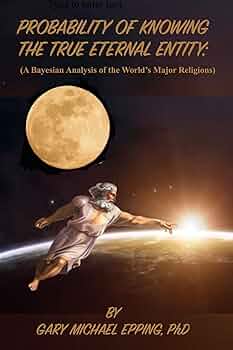
What if you could calculate the probability that one of the world’s major religions reveals the true Entity—the ultimate reality or God—behind existence?
In an age of endless spiritual claims, skepticism, and conflicting doctrines, seekers everywhere ask the same profound question: Which religion is true? Or is none of them? Traditional faith often demands belief without evidence, while pure atheism dismisses the divine outright. But what if we applied rigorous, objective reasoning—Bayesian probability—to evaluate the evidence?
Probability of Knowing the True Entity: A Bayesian Analysis of the World’s Major Religions offers a groundbreaking, evidence-based approach to one of humanity’s oldest questions. This book systematically compares the top five world religions—Christianity, Islam, Hinduism, Buddhism, and Judaism—using probabilistic logic to assess which (if any) most credibly points to the true Entity.
Inside, you’ll discover:
A clear introduction to Bayesian reasoning applied to religious claims—no advanced math required, just logical steps anyone can follow.
Key evidence weighed for each faith: historical records, philosophical arguments, fulfilled prophecies, experiential reports, moral frameworks, and responses to suffering/evil.
Side-by-side comparative religion analysis that highlights strengths, inconsistencies, and probabilities without bias or dogma.
Updated priors and likelihoods that let you adjust the model to your own starting assumptions—making this truly interactive and personal.
Honest conclusions about the probability of knowing the true Entity, including scenarios where agnosticism or non-theism scores highest.
Whether you’re a lifelong believer questioning your path, a skeptic open to new evidence, a student of world religions, or someone exploring spirituality for the first time, this book equips you with tools to move beyond emotion and tradition toward reasoned probability.
If you’ve ever wondered:
Does Christianity’s resurrection claim hold up under scrutiny?
Could Islam’s emphasis on monotheism give it the edge?
Do Eastern traditions like Hinduism or Buddhism better explain consciousness and suffering?
Is Judaism’s foundational role undervalued in modern comparisons?
…then this Bayesian framework provides the clarity you’ve been seeking.
Don’t settle for blind faith or outright dismissal. Explore the data. Update your beliefs. Discover the probability that points to truth.
Grab your copy today and begin your own reasoned journey toward knowing—or not knowing—the true Entity. $0.99 on Kindle.